Friday, July 29, 2011

MUSIC - The Rescue


Why a poster from The Rocketeer? That's right... this piece is another one which draws from the style of a film composer that I admire- in this case, James Horner (it also weaves in elements from a certain unfortunately-named but excellent trailer scoring group).

I'm interested in hearing all y'all's thoughts in the comments. There's one thing in particular that I'm not sure that I like about the piece- but I'm not sure that it's necessarily a bad thing either. One of my previewers mentioned it, and my sisters agreed- it's not very consistent in tone. Is that a good thing? Bad thing? Well, I look forward to hearing your answer to that question.

Oh, and I did use a few modes in here- there are touches of Phrygian, and some sweeping passages in Lydian which actually kinda just happened that way. It's really neat being able to recognize it, though- praise God, I'm learning!

Also, I think this piece contains my most sweeping, romantic, Hollywood style big strings theme yet.

So. Here it is.

The Rescue

Saturday, July 16, 2011

MUSIC - Mixolydia


My well-overdue piece of the week is a continuation of my journey through the modes. Much gentler than "Hero", this one is inspired by Desplat's score to "The King's Speech". I wanted it to be polite and relatively dispassionate.

Before I post the piece, I shall post a pondering.

Pieces like this are much less driving and exciting than pieces like Hero. I find it not at all surprising that while Hero has been on YouTube for (roughly- YouTube's estimate) 2 weeks, and Lydia for (same) 3 weeks, Hero has been viewed 110 times, and Lydia 58.

Why?

So having thrown that out for you to think about- and to comment on below ;-) - I shall now without further ado post the link to

Mixolydia

(This is also an excellent opportunity to say- praise God for all the views! The LORD has been bringing more work my way, and I'm quite excited about it. I've been very busy, and hope to continue to be so, so I don't know how consistent my posting will be, but praise God- it is He Who gives power to make wealth. Deuteronomy 8:18)

Monday, July 11, 2011

REVIEW: True Grit

Both of 'em, that is. And pardon if this review isn't as well-organized as would be nice... I'm busy right now- praise God!- and am really just trying to hack through this to get it out there, as I know some have been looking for it.


I'll get it out there right now. I liked Jeff Bridges' portrayal of Rooster Cogburn better than John Wayne's.

Whew. Glad I got that one off my chest.

This is another one of them thar compare-contrast reviews. I'ma gonna tell ya which one o' these here two pictures (that would be films fer you east-coasters) I liked better, and why I liked (or didn't so much like) either one 'tall.

The Characters

Mattie Ross

The headstrong hero of the film, Mattie is set on avenging her father's death.

Boy does this one give me a lot to ponder in the worldview section, but for now I'm comparing.

I definitely liked Miss Ross the newer, excellently acted by Hailee Steinfeld, over her predecessor.

I have to wonder why they went with the short hair in the old one.

The thing that worries me most about the film- not because I'm downright against it but because I'm not sure whether I'm downright against it- is the fact that Mattie Ross is out for vengeance against the murderer of her father. In the new film she tells her mother that that's what her now deceased father would have wanted. I really appreciated that line. She's trying to honor her father. She also tries to get the law to do its job- she hires a marshal. She's not just out to kill- she's out to see that justice is served. And if the law won't do it, she appears to want to do something reminiscent of the role of the Biblical "avenger of blood". It also appears that if she had had a brother old enough to do it then she would have gladly yielded that role to him. She's not a man, nor does she want to be, and that's a good thing.

She's not exactly principled in some of her dealings with the townspeople as the film starts out- I mean, come on, your father did buy the horses, and just because you have a good lawyer doesn't mean that you should threaten $300 out of someone that doesn't owe you $300. Excuse me, that would be $320.

La Boeuf ("La Beef")
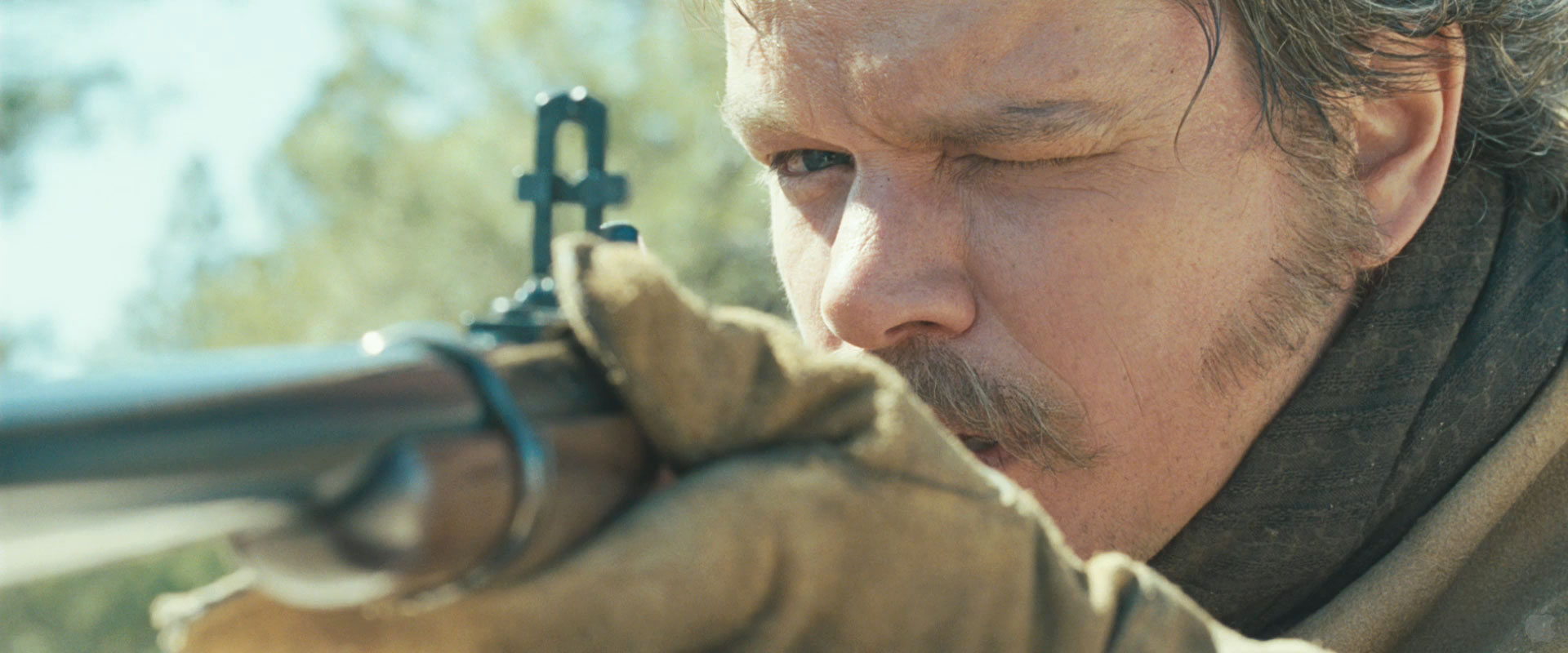
On this character I much prefer Matt Damon's version. Of course, I came into the film already a fan of his acting, so it's no surprise that that would be my conclusion.

He too is a flawed character, but his flaws are pretty obviously flaws. I really enjoyed watching Jason Bourne play somebody with a heart and some quirks.

"Rooster" Cogburn

Now for Mr. Cogburn. He's a drunkard, but this is portrayed as a weakness, if a point for some humor throughout. He's not a moral man- in the new one, he's twice divorced- his language is occasionally colorful and his methods aren't compassionate. "The love of decency does not abide in you," he quotes his former wife. In both films, he definitely has flaws which make him an interesting character. The one that worries me most is the Jack Bauer syndrome- while this probably is rather accurate in a Western story, he has no qualms about using threats, shooting first, or breaking promises to dead men. We have to be careful- just because they have the badge and are the "good guys" doesn't mean that they are above the law.

The Art


The Coen Bros. film was very well done. There were a few parts where I thought the score failed to deliver- it lacked a bit of punch at a few parts that really needed punch. That said, I liked the score overall. The cinematography was very good, though I was hoping for a few more "big sky" shots.

It's a very enjoyable film. The mix of humor and story is very pleasant, and the acting is first class.

The ending music, a rather unattractive rendition of "Leaning on the Everlasting Arms," was a bit disappointing. Love the use of hymnody in the score, but I could have done with a better version of the ending song perhaps...

There's a few parts in the film of very graphic violence which might cause concern, as well as a smattering of cursing- I think the cursing was worse in the old one, but the violence was most definitely more graphic in the new.

Is graphic violence bad? I don't think so inherently, but in case it bugs you behold- you have been warned. :-)

For more detail on non-family-friendly content I'd refer you to the Kids-In-Mind review here.

The John Wayne version is older. It lacks the polish of... newer films. So for a film of its time I think it was very good, but as far as the art goes I like the new one a deal better.

The Worldview

This is a tough one. Right off the bat I'll mention that the newer version of the film had a much stronger flavor of Christianity- from the opening slide with Proverb 28:1 ("The wicked flee when no one is pursuing...") to the hymns woven into the score to Miss Ross' references to Scripture and the free Grace of God.

And this I like.

But anybody can stick a Scripture or two in their film.

Something that I really enjoyed in the John Wayne version that I missed in the newer True Grit was the way that Mr. Cogburn repeatedly referred to Mattie as "Little Sister." While this phrase and variations thereon came up a few times in the new version, I really enjoyed the protective and familial relationship between Wayne's Cogburn and Darby's Ross.

The ending I liked better in the John Wayne version. In the Coen Bros.' film, we actually see Mattie grown up. She says she never had time to "fool around" with marriage, seems a bit bitter, and is overall a disappointing end to a character that I had really become attached to throughout the course of the film.

Some of the other worldview issues I already addressed when speaking of the characters.

Oh, one more- in the 2010 film Mattie *SPOILER* shoots an unarmed Cheney. Now, Cheney was worthy of death Biblically, and who knows how many variables would be going through Miss Ross' mind, but I don't know right off if she was right to do so, instead of turning him over to the magistrates.

Altogether,
I enjoyed the newer version a good deal better, and would recommend it over the version with Mr. Wayne.

True Grit (2010) - 4/5
True Grit (1969) - 3/5

Friday, July 1, 2011

MUSIC - Hero


While Batman is not my ideal for a hero- he doesn't live according to God's Law, nor execute justice according to God's Law- nevertheless, the picture is appropriate since my latest piece draws inspiration from Hans Zimmer and James Newton Howard's score to Batman Begins.

Enjoy, and please share as you feel led- as a young entrepreneur, I really appreciate the promotion.

Hear the piece here.

Monday, June 27, 2011

Book Review - Basic Economics

I consider Mr. Thomas Sowell to be my economics professor.

It's that simple.

Basic Economics is no small book, and it might appear to be frightening judging by the size.

It's not.

It's basic. In case you couldn't guess by the title.

And it is very much worth your read.

The Worldview

The Good

This book is basically an exploration of God's Laws as made manifest in economics- just the way that He designed His creation to work.

The Bad

If Mr. Sowell recognizes this, he doesn't point it out. It's written sans the fear of God- which is the foundation of wisdom.

I don't know what Mr. Sowell's religious convictions are.

But I know what my religious convictions are.

And so, reading through this book, coming from my fear-of-God perspective, I am able to, or at least desire to see all of the knowledge contained herein through the lens of- if it's true it's true because that's how God made it.

That's the big thing- this book doesn't acknowledge that what is is because God made it so.

There are other minor things that I am not "for", like women being in the "work force" and so on, which are taken for granted here, but that isn't my big issue with the book's worldview.

The Art

The Good

While I'm sure there were a few mistakes (I think I even caught a problem in one of the mathematical equations! Oh yes! *feels important*), it's a book by a human. Overall, it was very polished, readable, well-organized, attractively designed, and user-friendly. Mr. Sowell pours forth a wealth of examples to illustrate his points, and while I'll readily admit that there were still a few points that took me multiple reads to get, or even that I just downright didn't get, overall it is definitely an economics textbook for the common man. It also isn't concerned with pushing an agenda, and seemed to me to give a very balanced and honest (which equals a pretty conservative...) view of economics.

Ultimately, I want a Biblical view of economics- and as that's not what Mr. Sowell set out to give me, it's my job to filter this book through The Bible.

But for what he set out to do, he did very well.

The Bad

None worth mentioning.

The Content

Was downright excellent. Like I have said, it lacks a Biblical foundation, but when we bring the foundation along we can recognize that Mr. Sowell has built a really nice house to place thereon.

He covered so much so well, and there were so many "AH! I get it now!" moments.

The book discusses exploitation, monopolies, international trade, price controls, and so many other very practical topics.

For example, I now have a more practical understanding of something that I would have objected to Biblically all along- rent control. When the state steps in and tells private businessmen how much they may charge for rent, I already object to this because Scripture doesn't give that jurisdiction to the state.

But after reading Basic Economics I can also play it out for you- rent control comes in, so the incentive for landlords to care for their property goes down. The demand for rental properties goes up because, for example, a single young man, who in a free market would stay with his parents instead of paying $1,000 a month, now rents a flat for $500 a month. So there is less housing available. At the same time, it becomes less profitable to build housing for the poor, so scarce resources that would have been allocated to making more middle-class housing now are used to make upper-class housing which is exempt from the rent control.

So the policy that was supposed to provide cheap housing for the poor actually increases demand, decreases quality and supply, and everyone is worse off for it- landlords, renters, and the society as a whole.

Scripture is sufficient. We could have known it was wrong all along. But a book like this gives a wealth of knowledge that lets us see God's Word played out practically.

Some excerpts:
  • "As we have seen in earlier chapters, earning a rate of return on investment that is greater than what is required to compensate people for their risks and contributions to output is virtually guaranteed to attract other people who wish to share in this bounty be either investing in existing firms or setting up their own new firms. This in turn virtually guarantees that the above-average rate of return will be driven back down by the increased competition caused by expanded investment and production by either existing or new firms. Only where there is some way to prevent this new competition can the above-average earnings on investment persist."
  • "While government regulations may be defended by those who create them by referring to the benefits which such regulations provide, the economically relevant question is whether such benefits are worth the more than $840 billion in aggregate costs that they impose. In the marketplace, whoever creates $840 billion in costs would have to be sure to create more than $840 billion in benefits that customers will pay for. Otherwise that producer would risk bankruptcy. In the government, there are seldom any incentives or constraints to force such comparisons."
Altogether,

I would very highly recommend this book.

Buy your copy on Amazon here

I'd also recommend getting a good shot of practical wisdom from Mr. Sowell on YouTube.

Friday, June 24, 2011

MUSIC - Lydia


My piece for this week continues my exploration of the modal scales.

This one was written in the Lydian mode- hence the title- and, while being included with Phrygia in what I would like to complete as the "Modal Suite", this one is much lighter and less imposing- emphasizing, perhaps, the exhilaration of discovery and the sadness of having to leave what was just discovered, rather than the horror of finding oneself stuck in a hostile otherworld.

The story I'm envisioning: you have just discovered a new world- whether you've fallen down the proverbial hole-into-wonderland or have landed on another planet- and you excitedly begin to explore this new world. Then, as the piece climaxes, you realize you must return home, and while the solo piano ends the piece you think back on what you have seen.

Do you have a better one? Tell me about it!

Lydia - from the Modal Suite

Wednesday, June 22, 2011

Book Review - The Heart of Anger

I just finished The Heart of Anger, a book by Lou Priolo which is full of "practical help for the prevention and cure of anger in children".

Here are my thoughts.

The Worldview

The Good

Wow, what a joy to read a book that is so thoroughly Scriptural, in a blatant sense- Mr. Priolo makes no bones about his foundations being laid upon God's Word, and he denounces using man's wisdom as our guide for counseling.

The Bad

Mr. Priolo definitely doesn't come from the same perspective that I do in some areas. While we agree that Scripture is sufficient for all of life and Godliness- 2 Tim. 3:16- and this is huge!- I'd still suggest that some of the things that he accepts as normative need to be reformed in light of God's Word. Things like dating and public schooling are presented as normal in this book. I don't think that God's Word leads us to these things, so they're worth mentioning.

The Art

The Good

Mr. Priolo is fun to read and the book is quite accessible and understandable. The cookies are on the bottom shelf. He also uses lots of diagrams and illustrations that help with understanding.

The Bad

The grammar and editing in this book was less than perfect, and a bit disappointing. The cover design was a bit cluttered, too.

The Content

Was rich. Delicious. Highly recommended. Mr. Priolo covers many areas that need covered. He talks about manipulation- and how to deal with it, righteous and unrighteous anger, naming issues Biblically, house law (including the difference between Biblically directed rules and Biblically derived rules), idolatry and its implications for anger, and much more:

  • The appeal process: "The basis of an appeal is the presentation of new or additional information (preferably supported by a biblical desire and reasoning) that your child believes you as his parent have not considered in making a particular decision. Your child presents the new information along with its biblical justification/benefits (i.e. why the Lord might be pleased with a change of mind/decision) and without any further pressure allows you to reevaluate your decision. This process allows parents to change their mind without having to sacrifice parental authority. It also trains children to communicate desires biblically without resorting to disrespect, manipulation and other manifestations of sinful anger." (From Chapter 12)
  • What is manipulation? "To manipulate is to attempt to control. For a Christian, manipulation is using unbiblical means of controlling or influencing another person. More specifically, it is often an attempt to gain control of another individual or situation by inciting an emotional reaction rather than a biblical response from that individual." (From Chapter 9- after this quote, he goes on to give the example of Martha from Luke 10)
  • Diagnosing spiritual problems: "The only divinely-approved diagnostic manual whereby Christians may accurately judge thoughts and motives is Scripture. Christian parent, you must learn not only how to draw the thoughts and motives out of your child, but also how to diagnose those thoughts and motives; "not in words taught by human wisdom (i.e. defense mechanism, reaction formation, love hunger, codependency, etc.), but in those taught by the Spirit (i.e. pride, blameshifting, idolatry, bondage, etc.) combining (interpreting) spiritual thoughts with spiritual words." (1 Cor. 2:13)." (From Chapter 7)
His persistent use of Scriptural terms to diagnose spiritual- psychological- problems I found immensely refreshing.

Altogether,
I would highly recommend this book, to parents, parents-in-training, believers preparing to counsel other believers, or even to parents (or anyone!) struggling with their own anger issues. The Heart of Anger offers a wealth of Biblical advice on anger and what to do about it, and while it's specifically and practically applied to child-rearing, God's "commandment is exceedingly broad"(Ps. 119:96), and I'd be surprised if the principles and Scriptures expounded upon in this book didn't have a wealth of applications elsewhere.

Buy your copy on Amazon

4.5/5