Showing posts with label Biblical Womanhood. Show all posts

Friday, January 5, 2018

That Pesky Titus 2


“...that they may encourage the young women to love their husbands, to love their children, to be sensible, pure, workers at home, kind, being subject to their own husbands, that the word of God may not be dishonored.” - Titus 2:4+5

This exhortation to young women cannot be neglected; it is clear in the text, but it is not culturally acceptable today, and as such it is easy to let it go unmentioned. Sinful man is very concerned with self-definition, self-realization, and unbridled autonomy. But God is in the business of bridling His creation; He both creates and defines what He has created. Truly, He is the most qualified to do the defining, and it is in keeping His commandments that our joy is made full. The bridling of the horse unleashes its power. (John 15)

From my own limited experience and observation, it seems that about ten years ago this passage and its presentation of the homemaking woman was very much in vogue in conservative Christian circles; honestly, it was perhaps presented a little too unilaterally, without enough room for Christian liberty and variety in application. A home business was the only option for a single young woman who wanted to be financially productive. For a girl to consider a college education was heresy- maybe not punishable by the tribunal, but certainly deserving of concerned condescension. Christian womanhood was supposed to look the same way for everyone. But that never happens, and it isn’t supposed to. The tapestry of the Church is a varicolored tunic, not a straightjacket.

Now, however, we seem to have taken a ride on the pendulum; now, we not only embrace Christian liberty and variety, but we practically disembowel the Scriptural commands in the process. We have rejected straightjacket and varicolored tunic alike, and we are running through the streets baring our liberty for all to see. Now this passage really means nothing- yes, we accept it as Scripture, and we make a nod to some vague idea about the wife being the homemaker. But Titus 2 doesn’t really have much bearing on whether or not my wife should get a job, or whether or not our girls should learn old-fashioned homemaking tasks. Perhaps most damaging of all is the strong perception that keeping the home and raising the kids is a second-level calling, as if the passionate pursuit of this essential mission reduces a woman to being too easily satisfied. As if “stay at home mom” was equivalent to “the help.”

This passage does mean something, and we cannot shy away from it; we must let God speak. God has called women to a different role than men, and for a woman to set that calling aside is for her to take a step down, not a step up. God does call women to be home-centered (and He does call them to be subject to their husbands, since we’re already stepping on toes here). It is straightforward in the text. It isn’t for me or anyone else to define for everyone exactly what those two things mean in practice. But the point is that they mean something. The application of the principle will vary, but there must be an application.

We cannot be ashamed of the Word of God. His commands are good, and they bring life and joy.

If we do not embrace this facet of God’s design for His people, then we will give occasion for the Word of God to be dishonored.


Thursday, July 20, 2017

On Modesty and Dead Horses


Ah, we have dug up the corpse of the modesty horse from the backyard once again. Grab your bats, everyone.
But it's not really beating a dead horse; more like a zombie horse; some battles need re-fought, and some need re-focused. In all the back-and-forth, we may hope and trust that God is honing the effectiveness of His Church.
Like most issues, the modesty issue really boils down to whether or not we are seeking God wholeheartedly. If we are, we can grow in wisdom. If we are not, then we will dig into one side or the other and stay there.
Blamers gonna blame. Legalists gonna legal. Libertines gonna liber.
For the girl who wants to feel justified in dressing in ways that are worldly and reminiscent of the Proverbs 7 woman, articles like the recent viral wonderpost provide the perfect ammunition to cast blame on the men around her. 
For the guy who wants to feel justified in ogling his sisters in Christ, any given call to modesty for girls is the perfect ammunition to cast blame on the women around him.
So the real question is- have we removed the log from our own eye? 
Am I arguing for "modesty" because I'm unwilling to repent of my own sin, or maybe because I am desperate to uphold man-made standards and too proud to lend an honest ear to a critique? 
Am I arguing against "modesty" because I want to be free to dress the way that makes me feel beautiful, rather than the way that best honors Christ and serves others?
We are all responsible for how we dress- for how it represents Christ, and for how it affects others. We should be dressing for Christ and for others, not for self. This would obviously include having some sort of standard for decency (and I believe that that goes for both guys and girls- http://allauthority.blogspot.com/…/magic-mike-and-male-mode…). (1 Cor. 13:4-8)
We are also all responsible for how we think. Guys, if we don't take our lustful thoughts captive, our poor sisters could walk around in burkhas and we would find that their eyes were enticing. "Girl, the bridge of your nose is causing me to stumble." (Matt. 5:28)
And girls, it's also unfair to tell guys to keep their eyes under control while posting drool-stained fangirl comments about the screenshot of Mr. Hotness, coming in HD December 2017. I'm just sayin', all that drool ain't good for your keyboard.
Somewhere out there on the war-torn battleground of sexuality and decency is wisdom. 
The devil would be happy to convince us that God doesn't care, and to render us as Christians just as naked and licentious as the world. "You shall not surely die."
The devil would also be happy to see us fenced up in a bunker of our own traditions and legalisms, so focused on this or any other peripheral issue that the Christ that we claim to serve fades into the background. "Hath God said?"
And the devil would probably also be happy to divide us into the two above camps and keep us busy fighting between ourselves and representing a divided Christ to the world around us.
We all know (or should know) that some attire is not fit for the public eye. If we are humble enough, we should be able to discuss one another's standards, learn from each other, discover how best to love and consider each other, embrace liberty in Christ, and seek wisdom.
It's not "girls, wear what you want." It's not "guys, think what you want." We're Christians. The whole point of this thing is that for every one of us the command is crystal clear- "do what Jesus wants."
So let's humble ourselves and seek God together.

Wednesday, May 11, 2016

Feminism and Spandex


My daughter. Born May 7, 2016.

Our baby's name, Jael Bethany Hudelson, means the following...

Jael is called to be a fruitful, home-focused warrioress, like her Biblical namesake, and like her mother. 

Jael means "mountain climber" or "mountain goat;" our little girl is called to conquer obstacles and do hard things for the glory of Jesus Christ. 

Bethany means "house of dates;" Jael is called to bear fruit for the kingdom of God, both in her endeavors and accomplishments and, if God wills, in her womb someday. Just like her mother. 

The Biblical Jael was not a trained warrior; she was a homemaker who was courageous and capable enough to deal a decisive blow to the enemies of God. In the midst of a culture that holds up spandex-clad female warriors as ideal women, Jael's namesake represents a womanhood that is neither China-doll nor masculine; in the midst of a culture that counts dollars and not descendants, degrees and not dominion, Jael represents a woman who is fulfilled in her God-given role, keeping her husband's home; in the midst of a gender-confused and sexually perverse culture, Jael represents a womanhood which is clearly and happily feminine, even in her combat methodology; Jael represents a womanhood which sees her battlefield as the home. 

Jael is called to be a woman ready to put spiritual tent pegs through the temples of the ideological enemies of God like feminism, relativism, and political correctness; a courageous woman devoted to the Kingdom of God and not to her own comfort; a woman who, like her mother and grandmothers before her, will stand strong in the face of a culture that despises all that she represents. 

Jael is also called to be a woman who, if worst came to worst, could pour some literal milk and wield some literal tent pegs with deadly effect.

And then the symbolism of her middle and last names. 

Jael is called to carry on the covenant with Jesus Christ which her mother, Bethany, so dearly holds, and which is the most treasured legacy of the Hudelson name. 

It's all about Jesus, baby girl. 

Fill the earth. (Hab. 2:14)

-------

As an aside, talking about feminism and spandex... I just watched my wife go to war, y'all. I held her hand and gazed into her eyes as she fought to bring a baby into this world. I saw in her face more ferocity, more determination, more perseverance through incredible difficulty than any super-woman movie character on any Hollywood screen could ever pretend to be overcoming. And I couldn't help but think- why do women go anywhere else to pursue greatness? Why try and compete with the guys when you could do something they can't? Why develop unnatural strengths when you are created with such amazing natural strengths?

I remember discussing fitness with my sister and a friend, and my sister asked "well, if guys are better at upper-body strength, what are girls better at?"

I said "having babies." The sad thing is that in our culture, that is seen as insulting. And so we see how feminism has degraded womanhood. Instead of honoring the incredible unique power of women to be mothers and homemakers, we force them to measure themselves as laborers against the men who were designed by God to be those laborers. 

My boss told me about a visit to Discount Tire during which he saw a 120-pound woman struggling to torque tire nuts to the required near-200 ft. lb. requirement... And another woman telling her manager that she couldn't get six tires onto the top shelf... 

Meanwhile, the military reduces their physical fitness requirements so women can go to war. 

Meanwhile, women are celebrated for being the first woman to do something that a hundred men have already done. 

Meanwhile, my wife goes through labor. And I am awe-struck. I see a depth of power and ferocity that I never knew in her. I see the thousand yard stare of a terrifying warrioress. And I think- for a woman, surely any other accomplishment, any other career path cannot compare; any other paper or trophy hanging on the wall can only ever be a step down from a picture of another human soul brought into the world by the kind of labor only a woman can do.

Thursday, May 14, 2015

Mr. and Mx.

Watched a little segment on Fox tonight about how Amazon has removed the "Boys" and "Girls" filters from their toy searches and the Oxford English Dictionary is introducing Mx. as a gender-neutral alternative to Mr. or Ms.

He Who sits in the heavens laughs.  It really is quite funny to watch the gods of the politically-correct marketplace scramble to sandblast every remnant of reality off of the reality that surrounds them.  Predictably, like sweeping a dirt floor, it's not working very well.

Then one of the ladies on the segment talks about how the most we can say about whether there are real biological differences between boys and girls is that we don't really know.

So... let's run a few quick polls.

What does a doctor say when a baby is born?  "It's a _____"

Is the doctor right or wrong?  And if the terms "male" and "female" no longer refer to objective biological differences, then... what's the doctor supposed to say?  Do we need new terms that somehow can acknowledge an anatomical reality without acknowledging a spiritual one?  Or are we also questioning the anatomical reality?

Next poll:

Put a group of girls in an empty room.  Put a group of boys in an empty room.  Give each group maybe some sticks and rocks.  What are they going to do?

Next poll:

Ask your average girl what her ideal body would look like, and note the adjectives she uses.  Ask your average guy the same question.

Next poll (this one is fun):

What would be your initial reaction to a scene from, say, an Avenger movie, in which Black Widow is cradling Thor in her arms, carrying him away from a place of danger?

Now, reverse the roles.  Does your reaction change at all?

If so, are you a sexist?  Or are you just a normal person who has been wired by God to think in terms of reality?

Something to think about.  Oh, and I loved the other lady's comment at the end... "This just makes it harder to shop."

And thus is the world of political correctness.

Thursday, August 28, 2014

Godzilla on Patriarchy


Well HSLDA just threw a bunch of people, myself included, under the bus of public opinion.

Smooth move, Batman.

Before I start, I want to say something about the term "patriarchy," which is... a rather loaded word.  I insist on using the term because I'm tired of letting the world confiscate, misconstrue, chew up and spit out terms that represent well, sometimes explicitly, the teachings of Scripture- patriarchy and dominion among the rest.

Now, in response to HSLDA.  I genuinely appreciate their statement that they will continue to represent folks like me who disagree with them.  I do not so genuinely appreciate the unilateral slash-and-burn treatment given to the patriarchal heretics, especially since I would apparently be one of them.

Which isn't to say that I would adhere to HSLDA's representation of what patriarchy stands for.  In this article, the author topples arguments like skyscrapers in a Godzilla movie, and I'm happy to help Godzilla out by kicking down a few bricks, because I never liked the skyscrapers anyway.  But HSLDA not only destroys the skyscrapers- it blames all the wrong architects for their existence.

Just a few things that stood out from the article: "Treating children well and treating women well is intrinsically the right thing to do."

Remind me again what the battle cry of patriarchy, "Women and children first!", was talking about?  'Cuz I kinda forgot.

Here's another really good one: "Patriarchial teaching: Higher education is not important for women."

This is not only a gross (i.e. either ill-informed or intentionally dishonest) misinterpretation of the passage they cited, but it's also vigorously not true.  No advocate of patriarchy that I know would ever advocate, or has ever advocated, "keeping girls dumb." The validity of the college model for higher education is indeed questioned by many in my circles... and not just for girls.

This: "In sum, patriarchy teaches that women in general should be subject to men in general."

Is rather humorous, because that summary actually doesn't sum up the previous points listed (the ones that actually had citations, however misinterpreted they were); it makes a huge leap and a new claim which is indeed contrary to Scripture... and to patriarchy, which is about patriarchal headship- that would be fathers and husbands, men placed in a relational leadership role by Scripture, not unilateral male headship, AKA "hey random lady, make me a sandwich!"

There is also an element of gender roles that is a more general teaching of "patriarchy" (and of Scripture)- for instance, in the civil sphere, we would advocate gender distinctions in positions of leadership (Is. 3:12).  We also aren't a fan of putting women on the front lines.

This is all, I would assume, similar to the traditional complimentarianism that the author himself adheres to.

This: "Women are not to be the de facto slaves of men. Women are created with dignity equal to that of men. Women have direct and unmediated access to God."

...

...

...

Seriously?

That's a straw man par excellence, a powerful, vigorous, bold refutation of an argument no one ever made.

Like, ever.  Well, OK, I think Islam teaches something like that.

This: "Daughters should not be taught that their only and ultimate purpose in life is to be the “helpmeet” of a man."

I am glad that he said this.  In every critique, we would be wise to search out the seed of truth, however big or small, that we could learn from.  This is something I myself have had to wrestle through in the past, and we in "the patriarchy movement" need to be careful to distinguish between a very true Scriptural proposition- that woman was created for man, and that she was "created to be his help-meet" (Gen. 2:18)- with a false and dangerous application thereof- that the only purpose in a woman's life (or a man's life, for that matter) is marriage.  We treasure marriage, and so we should, but we mustn't idolize it.

This: "We have a really easy way to know God’s universal commands. They are written in the Bible."

I'm pretty sure we all agree.  Condemnations of extra-Scriptural legalism need to be had, but it might be good to stick to specific legalisms instead of taking a carpet-bomb approach to a large subculture of American Christianity.

This: "When it is claimed, for example, that God never wants any daughter to leave home until she is married, the patriarchy movement goes too far."

Again, good for us to hear; the Botkin sisters have done a great job addressing concerns like this in a few of their recent talks, one of which is entitled "It's Not About Staying at Home."

Yet critiques like these could perhaps be postulated better thusly:

"Hey, sometimes it seems like y'all are teaching this.  Are you sure about that?  Because I don't see that in the Bible."

As opposed to:

"Hey, y'all obviously all believe this as an inherent part of your system, so I brought my flamethrower."

This: "It is from their stories that I have learned that these men’s teachings are being applied in ways that are clearly unwise..."

Hold the phone.  Sounds like the problem is with the applier, not the teaching.  I seem to recall some of Martin Luther's teachings being applied rather, um, erroneously, yet struggle to justify a Burn Luther's Bones Facebook campaign.

This: "The personal failure of Doug Phillips in the area of marriage and his mistreatment of a young woman bears directly on the legitimacy of his teaching."

BURN THE PSALMS.  Because David gots issues, y'all.

(And before you build the straw-man that I am comparing the teachings of Doug Phillips with the Divinely-inspired writings of David- I'm not.)

Yes, "you will know them by their fruits."  Mr. Phillips' downfall is a worthy catalyst for a season of close examination, and indeed is reason for his stepping down from a leadership position (which he did).  But I don't follow Doug Phillips.  I follow Jesus Christ.  My family follows Jesus Christ.  My church follows Jesus Christ.  We were greatly blessed by the ministry of Doug Phillips and Vision Forum.  But insofar as we followed what they taught, we did so because what they taught was Biblical.  Even if they were the blind hog that stumbled across the acre of corn, the blindness of the hog doesn't change the sweetness of the corn.

This: "Teachers who claim that they speak for God on matters of personal opinion should be suspect."

Is always true, of course.

This: "Treating one’s wife with love and respect is the best antidote to patriarchy that I know of."

Is, by implication, an enormously slanderous and blatantly false representation of the teachings of patriarchy.

This: "But if officials believe that the homeschooling movement promotes teachers and ideas that inherently treat women as second-class citizens or result in physical or sexual abuse of children, then we can expect that homeschooling freedom will be negatively impacted."

If officials come to the conclusion that the homeschooling movement promotes these things, I fear that it will be largely because of articles like this.

Friday, August 22, 2014

Courtship: a response to a response to a response to a critique

Seriously. 


So, first, for context (you don't have to read all of these for my post to make sense, but do know that my post did not appear ex nihilo):


And now, for my response to a response to a response to a critique; namely, some thoughts on Mr. Woodward's concerns with the courtship model as advocated by Mr. Wilson.

-------

I'm a young man who has been graciously "turned down" three times by fathers who I really respect.  I'm a big fan of young marriage; I would love to have a wife, and continue to pray for one, and I'm very much looking forward to finding the woman that God has for me.

So, on first impression, it might seem that everything Mr. Woodward wrote is "on my side," and I should be very happy to see it stated publicly.  But that is not the case.  If Umstattd's article was a bowl of frosted flakes sprinkled with mushrooms, this article simply splashed a straw man into the milky mixture.

Mr. Woodward comments that, in the case of Mr. Wilson rejecting 14 of 16 suitors for his daughters, "That’s a failure rate of nearly 88%!"

Mr. Umstattd, in his article, rightly pointed out that the goal of courtship is marriage- at least if that is understood, in response to the idea of "casual dating," to mean that courtship is a marriage-focused get-to-know-you process.  Courtship isn't just chaperoned hanging out so that we can update our Facebook status; we're actively seeking to know whether God wants Boy and Girl to become Man and Wife.

So courtship is marriage-focused... but I would contend that the goal of courtship isn't marriage, if I may perform a little pirouette on my use of the term "goal" (bear with me).

One of the things I love about the courtship process is that the success or failure of a courtship is not and cannot be judged by whether or not it results in marriage.  A successful courtship is one which results in all parties concerned being able to move forward in singleness or in matrimony confident that they are doing so in the Will of God, and without having succumbed to a bunch of preventable temptations.  That's the goal of courtship.

I would say that, in the case of Mr. Wilson and his two daughters, both now wed to The One that God had for each of them, the success rate of their courtship would be 100%- and not just for the girls, nor for the happy husbands, but also for the rejected young men, who were blessed by God with clear direction coming in the form of a gracious "no" from the young lady's father.

To say that it's a matter of fatherly pride or a snobbish and highfalutin' family- does this not assume a great deal about the father and family of the daughter, to the point of being slanderous of them and planting seeds of bitterness in the hearts of the rejected young men?  Does it not also make the young man out as a helpless victim?

Encouraging fathers and daughters to not be over-picky and to have Biblical standards is a good thing, but laying the blame entirely on their shoulders and never stopping to tell the young men in the equation to man up, learn from the rejection, strive to improve and grow, press on, seek first the Kingdom, and praise God for giving clear direction- no wonder so many rejections happen!  We're making a bunch of rejectable young men!

"It's not my fault... it's those mean fathers... they just don't realize what an AMAZING HUSBAND I WOULD BEEEEE!!!!!  WAAAAAA!!!!"

"Oh yeah, he's totally the one for my daughter."

I don't mean to mock my wife-seeking brothers in Christ (remember, I'm in this boat too, y'all), but to say that it is just as much our job to be Godly, responsible men as it is the job of the fathers we talk to to shepherd the hearts of their daughters.  If we begrudge them for doing their duty, however imperfectly they do it, that's shame to our account.

For that matter, the young man has just as much right to conclude that the marriage isn't right and to move on!  The young man is no more under the magnifying glass of the father than the father, daughter, and their family are under the magnifying glass of the young man!

Thus, the boast of the courtshipper is not that courtship leads to rejecting a bunch of suitors.  The boast of the courtshipper is that courtship leads to rejecting the suitors that need to be rejected.

But the larger question is- what system of spouse-hunting is the one advocated by Scripture?  Courtship, ambiguous and imperfect though it be, represents the best model I have seen so far for playing out Scriptural principles like those found in Numbers 30.

And until the courtship approach is shown as unscriptural, all anecdotal evidence against courtship is really just anecdotal evidence for the fact that sin is a real bummer.

Wednesday, August 6, 2014

Trust

"Many a man proclaims his own loyalty, but who can find a trustworthy man?" - Proverb 20:6
Friendship clearly entails trust; the closer the friendship, the deeper the trust.  Our trust, however, must be framed in the context of a Biblical worldview.  This is what makes accountability just as crucial in any Christian relationship, because a Biblical worldview informs us that, contrary to what we'd like to think, our hearts are deceitful and desperately wicked.

As people grow closer to one another in friendship, the bond of trust also naturally strengthens.  Yet too often the amount of accountability in the relationship decreases with the same elegant equivalence as the heavy side of a see-saw.

It might seem that this is how it should be; doesn't trust enable relaxation?

Today I read another excellent blog post by Doug Wilson.  In one of the comments, a heartbreaking testimony is given by a woman who, years ago, was shamefully treated by her youth minister; this abuse didn't happen in the context of some unfathomable situation, but rather in the context of a situation which most of us probably never would have thought twice about.  He was just giving her a ride home.

Stories like this are all too common.

Is the answer to turn the old adage into a life motto- "Trust no one"?  Should we have an inner circle of friends that consists of Me, Myself, and I, and maybe my spouse on a good day?  Should the thought of a man at church shaking our daughter's hand send us scurrying for our shotgun?

Of course not.  It is good for Christians to grow in the unity of the Spirit and the bond of peace; we should indeed be able to trust one another (to whatever extent that trust has been earned).

Truth of the matter is, if I were to leave behind a widowed wife or father-and-brotherless sisters, there's no one on this earth that I would trust to care for them more than the families that attend my church.  I would trust them with my life, my family, my possessions.  That's what Christian friendship should lead to.

But that trust cannot be defined in such a way as to ignore the truth and inherent warning of Jeremiah 17:9.  I love and trust these people as my family in Christ.  But I know that their heart is deceitful and desperately wicked... and I know mine is too.

If our friendships are truly Christ-centered, truly open, truly free and honest, then there should be no shame in holding one another to boundaries.  We must not hide from the truth of our own sin nature.

If I ask a young lady to sit in the back seat and let my sister ride next to me up front- if a man from church says to my mom "hey, could we carbon-copy your husband on these e-mails?"- if a parent asks to sit in on their child's piano lessons- if a couple won't leave their children overnight at a friend's house for a sleepover (where did the idea that that was normal come from anyway?!?)- these are things that should not be a cause for awkwardness; they should be a cause for more trust.  I trust you because I can see that we both don't trust either of us left to ourselves; we both know that it is only by the Grace of Christ that we can continue to walk in holiness; we both desire to flee temptation. 

If we are truly hungry for holiness, then we should be happy when we find comrades who won't let us check out the other side of the menu.

It's not a matter of "eew, you might be a creep, no, my daughter can't ride with you alone for 8 hours to visit her aunt."  It's a matter of "but by the grace of God, we all would be creeps, so let's do our level best to help each other walk in the light and flee temptation."

It's not a matter of "I think you're a wolf in sheep's clothing" (although if you see a fang or a long gray tail, that wouldn't be an inappropriate observation); it's a matter of "we all have the heart of a wolf clothed in the robes of the Lamb, and until that wolf is slain in Glory this sheep will wrestle with the hunger pangs of a carnivore."

There is no benefit to be found by leaving the eyesight of the Shepherd or His flock; there is nothing to be gained outside of the confines of His pastures.

If anyone is afraid of boundaries, or uncomfortable with accountability, or maybe just thinks they are unnecessary- indeed, if anyone does not desire the transparent honesty of some form of protective standards- then that should be reading danger symbols on the Trust-o-meter.

"Therefore let him who thinks he stands take heed that he does not fall." - 1 Corinthians 10:12

Thursday, July 31, 2014

Strength... or maybe Dignity


"Strength and dignity are her clothing."

It's a dichotomy seen in both our perception of male and of female roles: there are two kinds of men, the macho and the gentleman, and never the twain shall meet; there are two kinds of women, the manly superwoman and the gentle and quiet "priestess of the house."

Yet Scripture puts strength and dignity together. Adventure racing, antarctic journeys, and getting lost in the woods on purpose with nothing but a pocketknife and dental floss may not be everyone's cup of tea, nor is it less Spiritual for a man or a woman to be passionate about things other than mud and blood and sweat. But every Christian is called to be ready to do hard things for the Kingdom of God. 

I might step on some toes, here, but I think we in modern America have classified some things in the category of "rugged manliness" that should not at all be male-only qualities.

It seems a normal, standing joke that guys may like going camping out in the woods without running water, but that to ask a lady to do that is laughable.

Sacagawea, the women of the Mayflower, the brides who went west, and missionary wives like Elisabeth Elliot might have something to say about that.

Civilization is a wonderful thing, but sterility is not. If a broken air-conditioner or a cold shower is a heavy trial, how will we be prepared to take on greater refinements dealt by the Hand of God and consider it joy?

Sunday, June 15, 2014

Exclamation Points


I've been blessed with amazing parents.  Sometimes I take that for granted.  As I get older, I begin to see that my parents are (gasp!) not perfect; sadly, because of my own sin, I am often like a man who leaves a five-star, fifteen-course meal and is only able to remember that the waiter forgot to put lemon in his glass of water.  Because I fail to see with the eyes of honor and of love and of a child who never questions that "my daddy can whoop your daddy," I so often miss opportunities to praise God and admire my parents.

It's not just a matter of imperfection, either.  I've always lived in a Christian home.  I've always been homeschooled.  From Square One, the reality of God and His Word has surrounded me.  I don't know what it's like to be fatherless.  To have parents who yell at each other.  To wake up every morning wondering if Mom will still be there, or if she's finally made good on that threat of leaving.  My parents aren't perfect, but as far as imperfect parents go, they are among the best.  Yet because I have dined at this five-star, fifteen-course meal every day for twenty years, I am too often deadened to the delicious taste and the amazing, deep satisfaction that it offers.

This isn't to say that I don't appreciate it- praise God, I do!- but rather to say that I don't want to be among the number of sons who realizes, as they say goodbye to their father or mother for the last time, that they didn't appreciate it enough.

"Grandchildren are the crown of old men, and the glory of sons is their fathers." (Pr. 17:6)

"Her children rise up and bless her..." (Pr. 31:28a)

Psalm 71 makes a beautiful and poignant statement about the duty of Christians to praise God for Who He is and for what He has done.  This is a primary way for Christians to glorify our Heavenly Father (also see 2 Cor. 4:15).

Are we not to do the same for our earthly father and mother?  Are we not to thank them and to bless them?  

This is why Mother's Day and Father's Day are so important.  I have been convicted of my failure to put the emphasis on these days that I should.  I have often neglected to buy gifts, make cards, do the sweet nothings, because it just didn't seem like that big of a deal to me.

Yet these are opportunities.  Memorial stones.  Exclamation points on the end of the 5th Commandment.  I don't want to miss them; I don't want them to pass me by like shooting stars in the sky above a text-messaging teenager.  

Praise God for His rich mercy, both in covering over and in sanctifying my weaknesses!

But, O God, give me the grace to take advantage of the opportunities that I do see!  And to see them more and more!  

Every time I write that card or buy that gift, that's another reinforcement of a habit and culture of honor.  A 5th-Commandment culture.  A blessed culture.  May God give us the grace to make that the culture of our homes.

Now, if you'll excuse me, I need to go fill out a Father's Day card.

Thursday, January 24, 2013

Gender Roles from the Bakery

So the Pentagon is opening up more combat roles in the military for women.


Yay! More opportunity for our precious daughters to get shot up and maimed! Progress and stuff!

So glad we got to the point where, as a nation, it's no longer un-cool to send your wife or daughter downstairs to check on the scary noise at night.  For a moment there, I thought I might actually have to protect the women in my life.  THANK YOU, PROGRESS!

My life will be so much more satisfying now that I can guiltlessly choose the path of impotent, bubble-wrapped mediocrity.  Or maybe it'll just be easier... not sure about the whole satisfying thing.

Gender roles?  Can I buy those at the bakery?

It's not like I ever wanted my sons to learn what it meant to love sacrificially; to lay down their lives for their sisters and their wives; to be men who were prepared to come to the aid of the weak and the oppressed.

I mean, goodness, can you imagine how oppressed my poor daughters would be if their brothers opened doors for them all the time?  The chauvinism.  

And if I ever come across a girl being attacked in a dark alley, well, I certainly wouldn't want to interfere with her opportunity to show her equality!  Though I gotta say, I hope she went to the same school of womanhood as Black Widow and Catwoman and all those other movie stars.  

And if she doesn't make it out of the alley alive, no reason for me to lose sleep! Natural selection has worked its will once again!

But I do have one more request.  While we're progressing, and being equal, do you think we could make registration for the draft mandatory for girls, too?  Just being fair 'n stuff.

Tuesday, October 9, 2012

REVIEW: The Avengers


The Avengers was a fun ride. Like its Marvelous predecessors, it managed to serve up considerable amounts of cheese, but a well-paced story, an ensemble of engaging and quirky characters, and a heavy dose of artistic excellence kept the film both engaging and enjoyable.

The Art 

The Good 

There's a lot to say about the quality of the films that Marvel has been pumping out recently. The crisp, clean videography, combined with directorial panache, make them a pleasure to view- even when they aren't a pleasure to watch. The music, while perhaps not always amazing, is usually tasteful and at least industry grade. Sometimes we are even treated to some great themes, like in Silvestri's Captain America.

In The Avengers, I thoroughly enjoyed the script, which was full of witty banter and genuine humor. Many of the actors also sold their parts very well- particularly Robert Downey, Jr.'s Tony Stark, whose sense of humor and sense of humanity rescued the film from rising amounts of cheese on multiple occasions.

"Doth mother know you weareth her drapes?"

The story, too, was more satisfying than that of some other Marvel endeavors, neither feeling rushed nor long-in-the-tooth. I suspect that these three things combined- the well-scripted, entertaining, and endearing interactions of the well-acted characters in an engaging story- are the strongest points of The Avengers' art, and are largely responsible for its remarkable success.

Then there's Loki.


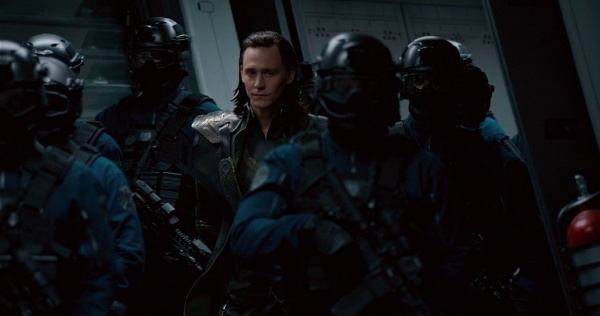
Many a good film lacks a great villain.  Not The Avengers.  Loki is at once evil enough to hate, personable enough to like, and human enough to sympathize with- all without there ever really being a blurring of the lines of good and evil.  The strength of the hero(es), it has been said, can only be as great as the strength of the villain.  Loki was not only a convincingly formidable opponent- he also just felt believable.  Even with the goofy helmet.

I found Silvestri's Avengers theme very appropriate and well-used, and the impressive visual scope of the film is also definitely worth mentioning.


The Bad 

I mentioned cheese, and I shall mention it again. Though the good points of this film rendered the cheese to be eminently bearable, the fact still remains that Velveeta made many a cameo in this filmographic masterpiece. From moments of stone-faced "I'm awesome"-


to exploits too unbelievable even for supermen-


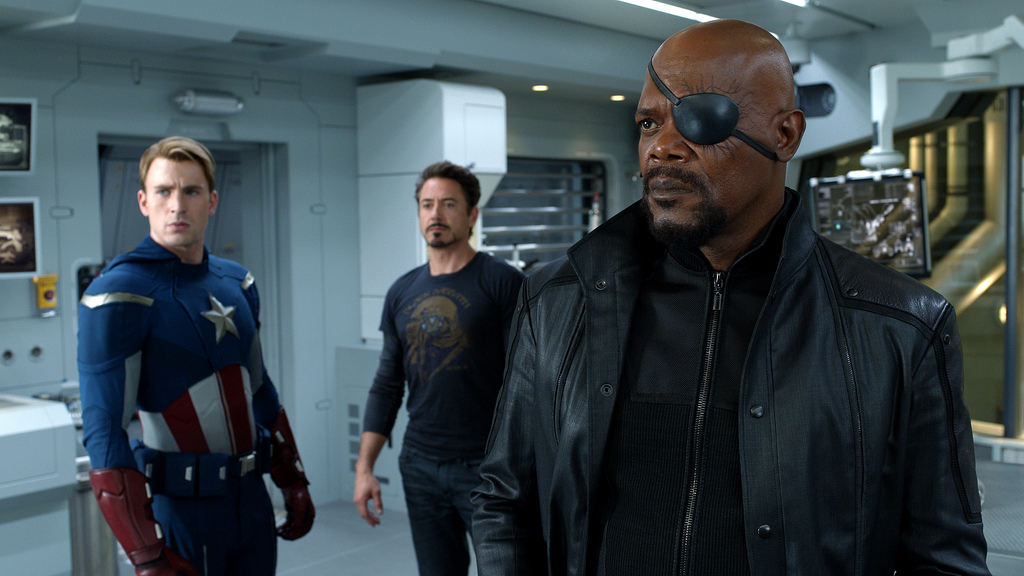
this film delivers an exquisite array of some of the finest cheeses this aficionado has ever tasted. Firing two pistols at once may look cool, but I don't recall ever seeing a real soldier running into battle wielding both his Glocks at once.  Talking of cheese, I think the film would be rendered more effective if the names of the characters weren't so far-fetched. Nick Fury? Seriously?


The egalitarianism in this film is something that I'll go into more depth on in the worldview section, but the truth is that androgeny isn't just bad philosophy- it's bad art, too. To portray a woman fighting with and overpowering men like this film does begins to smell like an ideology being forced into the story, at the expense of art, realism, and even the story itself. (I mean, seriously, it would be corny enough for a guy to snap out of a chair in which he is bound and level a room full of interrogators!)

The graphics were good, but at some (otherworldly) points I found them a bit ridiculous- at once not creative enough and overly bizarre. I found some of the costuming, too, a bit fantastical, especially on the SHIELD ship, which felt more to me like the Starship Enterprise than the USS Enterprise.


The Worldview

The Good

There is a lot to be admired in the eccentric group of people known as the "Avengers", and there are some quite good morals to be taken away from their story. Captain America remains my favorite of the heroes, being a strong leader, a moral man, and a man of principle devoted to ideals higher than himself.

"You know, the last time I was in Germany and saw a man standing above everybody else, we ended up disagreeing."

And his line, "There's only one God, ma'am, and I'm pretty sure He doesn't dress like that," was my favorite line in the film.


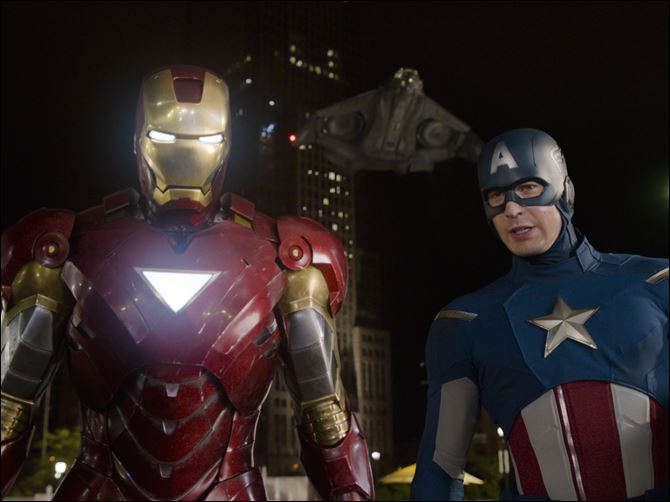
One of the strongest moral messages in Avengers came from the ongoing interchange between Steve Rogers (Captain America) and Tony Stark. The climax of their rivalry came as Rogers accused Stark of being, in a word, selfish- being a man unprepared to lay down his life for a cause greater than himself. Stark's reaction shows that, deep down, he knows it is true. But in the final moments of the film we see Ironman make a decision that proves that he is more than just an immature playboy in a robot-suit- that he is prepared to do the right thing, even at risk of his own life- that he is a real man.


Real men are prepared to make sacrifices. Real men are prepared to lay down their lives for the innocent and for the Truth. The greatest example of this, of course, was given by Jesus Christ Himself- Who went beyond laying down His life for the innocent, and gave it for the guilty. So this message, and this character transformation on the part of Tony Stark, was a very strong and beautiful portrayal that added depth to the film, power to the story, and genuine character to the personality of Ironman.


The Bad

Of course, Ironman also deserves a mention in the not-so-great section of my worldview analysis. His self-described playboy character is incompatible with a Biblical definition of what makes a hero. Tony Stark is likable, he is funny, he even does heroic things, but until he submits to Christ, no act of heroism which he makes can make him truly a hero.


Miss Natasha Romanoff is also a character in need of redemption (for what, exactly, the film does not specify). Somewhat like Mr. Stark, Natasha seeks to erase the "red in her ledger" by committing acts of heroism.


This is a picture of redemption that is futile, unsatisfying, and contrary to Scripture. Miss Romanoff needs to find her redemption and identity in Christ. Only by the blood of The Savior can the red in her ledger ever be fully washed away. The Scriptural picture of sin and salvation is not the balancing act of yin and yang. No amount of good deeds can outweigh the evil of a single sin to make the sinner holy and justified in the eyes of a thrice holy God. The wages of sin is death, and without the shedding of blood there can be no remission of sin. Praise God for His marvelous mercy in providing a way for sinners like me- and like Natasha, were she a real person seeking redemption- to be saved. What a glorious gift.

Natasha also embodies one of the most dangerous messages of this film- feminism, all growed up. She isn't alone, joined in the ranks of he-women by Nick Fury's gun-totin', pants-wearin' secretary. 


(STRAW MAN ALERT: "Gabriel is saying that women should never carry guns or wear pants or they are wicked feminazis!" No. I'm not.)

Throughout the film, we watch Miss Romanoff fighting men and monsters indiscriminately. The androgeny is thorough, and apparently no one, the whole film long, gives a second thought to the fact that they're fighting against (or alongside) a woman. Would a man like Captain America, with the chivalry of the WWII era still strong in his mind, even consider treating a woman- regardless of her ability- like just another soldier? More importantly, would Jesus? (Neh. 4:14)


My siblings and I have been listening in to the Botkin sisters' excellent webinar on what the Bible has to say about beauty, specifically in the realm of feminine fashion. Last Tuesday, the webinar featured an analysis of the fashion of certain eras and how those fashions correlated with the culture's view of womanhood at the time. What does Natasha Romanoff's wardrobe say about America's view of women today?

I submit that it says two things, loud and clear:

1. We see women as indistinct from men in any significant way beyond the obvious physical differences. The costumes of the heroine are very utilitarian, with no frills, no skirts, no lace, no feminine touches whatsoever. Men don't usually spend much time beautifying themselves. Neither does Natasha, nor the new woman that she represents. She dresses to kill.


(STRAW MAN ALERT: "Gabriel thinks that women aren't anything more than eye candy and their primary job is to look pretty for their husbands." Nice try. Wrong.)

2. We really enjoy drawing attention to and sensualizing the obvious physical differences. Let's be honest, folks, the skin-tight wardrobes of the primary female characters in the film are immodest. They're sensual, shapely, and suggestive. Just because she's covered doesn't mean that she is covered. Miss Romanoff is dressed to kill in more ways than one. (Pr. 7)

(By the way, some of our male heroes could do with a wardrobe increase of a size or two. Steve Rogers has no more right to showcase his muscles than Natasha Romanoff has to draw attention to her curves.  I've heard enough girls drooling over Thor that I'm ready to suggest a looser pair of trousers.  Male modesty is different from female modesty, but it isn't less important- more on that here.)

So, really, in the name of making women equal, the feminism and egalitarianism that we see in films like The Avengers does just the opposite. It degrades womanhood, casting it aside in favor of a perverted mixture of sensuality and androgeny. It reduces both men and women to their anatomical differences, making them objects to be consumed, lusted after, and used, while any significant distinctions in role are cast aside. What kind of liberation is this? It discourages Biblical manhood in favor of a feminized and soft masculinity, and it erases Biblical femininity, sending the women to the front lines to fill the role of the men whom it just sent away from the battlefield!

Men, we need to take the lead. Be the man. When something goes bump in the night, don't send your wife out with the gun. I don't care if she's a Russian-born assassiness. It's our job and our calling to be both the physical and the spiritual protectors of our families. It should also be our joy. We've abdicated this position for far, far too long.

Ladies, come home! Not just in the basic stay-at-home-mom sense, but in the deeper sense of being a keeper of the home, who loves being a wife, a mom, a sister, a homemaker, a woman. Don't let the feminists set the narrative. Don't buy their lie. Natasha Romanoff will never have as much impact on the world as one faithful mother.

One more observation. There were a couple of scenes where Miss Romanoff was in serious danger, and the tough-guy bravado peeled away for a moment.


In those moments, she seemed small, soft, feminine. In those moments, I wanted to protect her, to rescue her, to be her knight in shining armor. Most of the time, she was hard and masculine, and I was kinda left hoping one of the guys would show her up.

"Sorry, miss, but you've only trained to be a man.  I was born one."

Even better, that one of the guys would treat her with gentlemanly courtesy and expect her to act like a lady, instead of accepting her as "one of the guys."

(Note- I don't mean to suggest that "showing her up" would be a proper course of action on my part or the part of the male heroes, and I hope that if I met Natasha Romanoff I would treat her with the same courtesy, chivalry, and love that I aspire to treat all women with.  For me to try to "show her up" would be a violation of the very principles that I'm talking about in the first place.)

(STRAW MAN ALERT: "Gabriel thinks that women should be fearful, weak china-dolls who can't do hard things, can't work hard, can't sweat, can't use a gun, can't throw a punch, can't protect themselves and their families." Wrong on every count.)

Manly Amazon-womanhood trades in chivalry for competition, and the immense value of the gift of femininity for a cheap wannabe-masculinity.

This competition isn't a problem with the male heroes. In their case, I would be equally glad to have a friendly tussle or to fight alongside them against the bad guys.


Indeed, I would certainly enjoy the competition ("Come on, Captain, let's see who can do more push-ups!"), and there would be a mutual friendship and respect and camaraderie that just would not be there between myself and miss Romanoff- so long as she insisted on me relating to her as a man.  I mean, really... what guy wants to lose in an arm-wrestling match with a girl?  And what guy really wants to win in an arm-wrestling match with a girl?  He's left with two bad options.  That's a real bummer of a competition.  (The right choice? The third option.)

So, ironically enough, the only way for me to truly relate to Natasha with the same feeling of togetherness and unity as I would with the guys would be if she lived out a different role from my own.  Only then could we enjoy true equality.

She can never be equally as manly as the men.  Even the good ol' egalitarian US military, now proudly sending the precious daughters of our country into front-line combat to be shot-up and mutilated (yay for progress!), still has different- easier- physical fitness requirements for women than it does for men.  How does this make any sense at all?

If she seeks equality by becoming a man, she will be disappointed, because she is not and cannot be equally manly.  She was never supposed to be.

But if she seeks equality by seeking womanhood she becomes priceless.  Now she can become everything that she was created to be- a helper suitable for the man.  (Gen. 2)  Now we have true equality- each of us fulfilling our God-given roles, finding equal value in different purpose.  Now we complement and need each other (because even as she was created for the man, remember that it was not good for the man to be alone either!).  Now the woman needs the man to be what God has called him to be.  Now he needs her, because she is something he isn't, and she does something he can't.

Of course, ultimately, our goal should not be to find equality, but to find Christ.  To seek first The Kingdom of God, and His righteousness.  Then comes the rest.  Praise God, included in that little "the rest" is not only equality as brothers and sisters in Christ- but also the amazing privilege of being joint heirs (though we could never be equal) with Christ Himself!

So I thought the two major worldview weaknesses with The Avengers were feminism and a false portrayal of redemption by our own good works.

Some other issues worth mentioning:

Thor and Loki are supposed to be gods.  The film makes light of this, but they do wield supernatural powers.  Captain America's line really rescues this issue for me, but it's still important to remember that anyone but The One True God claiming godhood isn't a joke, it isn't funny, it isn't artistic- it's blasphemous, sinful, and wrong.  We can find other ways to tell our stories, without toying with things that are not for us to touch.  May God give us the eyes to see these things as He sees them.


A related point to this is the almost Scriptural importance given to the Tesseract- an object which one character says is more than knowledge- it's truth.  This is an eerie contradiction to Christ's claim that He is The Truth. (Jn. 14:6)

On a similar note, the earth does not need Thor's protection- we need the protection of Almighty God.

Our heroes have a good bit of rivalry shared between them, which isn't necessarily bad worldview on the part of the film (it's not shown as a good thing), but which does provide a great opportunity to discuss pride, gentle answers which turn away wrath, and so on. (Pr. 15:1)


Mr. Banner- the Hulk- is always angry?  That's not an admirable or heroic trait.


The topic of aliens and other worlds is also one that may warrant discussion.


Overall,

I really enjoyed The Avengers.  Fun, funny, yet meaty, with a surprisingly good moral to the story, it's one I'll definitely watch more than once.  It is worth mentioning that I watched a cleaned-up version, so while I know that there was some bad language, I didn't hear any!  Also, along with the tight clothing throughout, one of the opening scenes involves a woman in attire that shows more skin than would be preferable- parents be wary.  Children might also be scared by some of the alien creatures.  There are a few mild innuendoes also woven into the script.  That said, for a "grown-up" movie, The Avengers was pretty clean.  Despite the occasional shot of cheese, I found it well worth the watch (unlike some other superhero films that I've seen recently...), and thoroughly enjoyed the ride.  I look forward to seeing it again.

4/5


Wednesday, July 18, 2012

Feminism- All Growed Up


Dear girls,
Feminism is growing up.


It used to be enough for you to claim psychological superiority- to wear the spiritual pants- to hold the esteemed position as the only thing that stood between males and barbarism.


No longer.  Now, not only are you better than the guys- but you're one of them, too.


Not only is the new femme fatale seductive and shapely (sorry, guys, I'm really trying to find semi-modest pictures here), but she is also just as strong, just as fast, just as deadly as the men.


Some of you are just discovering this, but hopefully more and more girls will grow up with this realization instead of finding later that, for so long, they believed the myth that men had something that they needed.

Hopefully this message will reach them while they're young.


Don't worry- guys love it when you protect them, save them, lead them, beat them up when they need it.  Nothing inspires them like being led into battle by a woman.


It's no trouble for you, of course- you're used to doing everything else for them anyway.  Besides, the world needs you.  Men just can't do what you can do.


Especially not in a dress and high heels.


The world doesn't need that whole "gentle and quiet spirit" thing anymore.  It's passé.  What do you have to be gentle and quiet about?  Anything men can do, you can do better!

Which makes me wonder- what do we need men for, anyway?

They're so violent.


Sincerely,

A Man (I'm sorry about that)

P.S.

You may still have my seat on the lifeboat, if you want it.

Wednesday, May 30, 2012

REVIEW: The Hunger Games


The hype and hubbub surrounding this film has been ferocious. It has been praised for extolling the value of life and accused of preparing the way for Nazi Germany- both of which by people whose opinions I highly respect.

At first, I didn't want to see the film. I knew I would enjoy it- and I wasn't happy with that. It seemed like the perfect blend of toxic worldview with artistic excellence- a classic example of situational ethics- a deadly trap for the teenage romantic imagination- the kind of film that would thrill my flesh but burden my spirit.

After all of this blazing controversy, however, I've been looking forward to seeing it for some time now. Yesterday, Dad and I marched into the theater with the express purpose of taking the film captive to the obedience of Christ.  After seeing the film, we made our way to a coffee shop in our local Barnes & Noble and set to writing down our thoughts, throwing our voices into the arena of the blogosphere.


Before we get started, please know this:

We are aware that The Hunger Games are actually three books, and that the books surely provide more context, more resolution, more detail, more information. However, we are analyzing this film on its own merit. Whatever the books construct as their worldview system is irrelevant to our purpose, which is to explore the worldview infrastructure of this film as such.

To whom it may edify, here goes:

The Art

The Good

The film was very well done.  The cinematography was intricate, the score was masterful, and the acting was first-rate.  The graphics were very good as well.  The whole film was very industry-standard.  A few things stood out: the story, the world-building, and the close-ups.

The story was gripping, intense, and powerful.  In a day of shallow, insipid stories, The Hunger Games has a plot that is deep and well constructed.  The tension was constant, but varied, so that the film was always gripping but never monotonously so.  The filmmakers made good use of this, using the story to drive the film instead of relying on "secondary strengths" like graphics or gore.


The makers of the film constructed a very believable visual world.  The use of costumes, make-up, and set-creation made the world of The Hunger Games unique and fascinating- as well as garish and disgusting where it needed to be.


The film made extensive- and skillful- use of close-ups, and perhaps was to close-ups what the Bourne films were to shaky-camera cinematography.  Which leads us to...

The Bad

...the shaky-camera cinematography.  I found it a bit frustrating in the beginning, not being able to get my visual bearings.  This leveled out very nicely for the majority of the film, though, and Dad also points out that it created a feel of disorientation and captivity very fitting to the film's opening.

The credits music was, in my opinion, a real let-down.  That happens a lot.

Overall, though, the art in this film was top-notch.

The Worldview

The Good

The structure of the film is very anti-statist.  The social commentary written into the story is powerful.  The film leaves the viewers wanting the districts to rise up again- to fight for liberty- to be free.  The tyrannical government of Panem is all the more disturbing when one compares it with the encroaching government of today.


Throughout the film we see the oligarchs controlling- or attempting to control- the will of the people.  The actions of Katniss and Peeta, our protagonists, trouble the plans of the tyrants, and awaken sparks of that same fire that led the districts to rebel years ago.  We found a strong parallel between this control of the masses by the media and the same power wielded by the American media today.  It was also admirable how the protagonists used the enemies' own tactics against them, wielding the media against the establishment.


The social commentary offered by the culture portrayed in the film is also instructive. The culture of the "bad guys," in the big city, is very shallow.  It's a facade, a glimmering show of makeup and shapes and colors.  The Hunger Games are seen as just that- as games, a cause for merriment, jokes, and laughter.  The portrayal of young people slaughtering each other with lighthearted enjoyment is not only chilling but terribly true to the nature of sinful man.  Give a humanistic society enough time, and death-games are the logical result.


Dad points out that the film did not portray the heroine as an invincible masculine machine who could pin all the boys down with one hand tied behind her back.  Katniss was skilled with a bow- but that was all.  There was none of this "just-as-strong-as-the-men" nonsense, and we greatly appreciate that.  She was very feminine throughout the entire film.


The Bad

I have never found it attractive when women swear.  Why Katniss does so multiple times in the film- especially since she is almost the only one to do so- is a total mystery to me.  It was not necessary, it was not edifying, and it was certainly not the language of a heroine.

Overall, the film is impressively clean.  The language is minimal, the violence is not nearly as graphic as it could have been, and the love scenes stayed away from anything beyond some kisses.  Which I still could have done without, of course.

The romance itself was interestingly woven.  On one hand, it was an effective tool of deception by which to play the system against itself.  That, I have no quarrel with.  On the other hand, it raises some serious questions and models "young love-" infatuation without any foundation- kisses without covenants- something which we see more than enough of already.

I can also see a love-triangle a'comin' in the sequels.  I sure hope they don't ruin the series with teen drama.

A Question for Peeta

Peeta states early in the film that he doesn't want "them" to change him.  Katniss asks if that means that he won't kill.  He doesn't mean that.  One is left wondering what he does mean.

Of all the ways to remain unchanged by the games and their masterminds, what greater way than to stand in defiance of their godless commands and say "No!"


The Big One

With a film like The Hunger Games, the primary question is this: when is it right to take a life?

It is never right to take an innocent life.  (Ex. 20:13)

It is always right to protect innocent life. (Neh. 4:14)

The "Just War Theory" has some relevant points to add to this discussion.  According to the Just War Theory, aggression is condemned.  Only defensive war is acceptable.  The cause must be just.  The use of force should be a last resort, and should be applied only in the proportion necessary to stop the foe- we don't need to fight someone for insulting us (Matt. 5:38).  Dad likes to say "eliminate the threat."  We're at war until the threat to peace has been eradicated.  To take this from a national to a personal level, self- and other-defense stops the moment the attacker does. It's not about killing them, it's about preventing them from harming the innocent.  Maybe that will require lethal force, and maybe (hopefully!) it won't.  At the root, though, we are pursuing peace (Matt. 5:9).

A key distinction here is that a Christian philosophy of defense leaves the attacker's fate in his own hands.  It's his choice to attack, and it's his choice to stop threatening the innocent.


The Christian worldview holds that man is evil (Jer. 17:9) and needs restrained (Ex. 20).


I would like to bring into the discussion two other very different films- one of which we watched yesterday, for Memorial Day.  The black-and-white classic, Sergeant York, is a film with much the same premise as The Hunger Games- that it is right to take life in order to protect life.  The other film (which is actually a TV show), 24, on its face preaches the same message.  The crucial distinction between the messages of Sergeant York and 24 is this- that one justifies the killing of the attacker in defense of the attacked, and the other justifies the killing of the innocent in defense of the other innocents.  Scripture portrays the defense of the innocent as not only the right but the duty of every righteous man, but this is done only by resisting the attacker.  Never are we permitted by the word of God to do anything otherwise.  To choose the "lesser of two evils," to take an innocent life in the name of saving a thousand others, is to sin, to violate the Law of God, and to become a murderer oneself.

This is a second key point in the Christian philosophy of violence- Christian violence is wielded in defense of the innocent directly against the attacker.


The Hunger Games stays on the right side of this crucial distinction.  Like Sergeant York, the protagonist uses force only when necessary to preserve herself or other innocent people.

Here we come to the third and final line that I would like to draw in this section: that humanism always leads to death, in a very literal way.


Sergeant York sees the world through a self-consciously Christian worldview construct.  The argument is over what The Bible says, and the conclusions that Sergeant York reaches are based on Scripture.  The Hunger Games gives us no such standard.  We all know that Katniss did the right thing, because The Law of God is written on our hearts (Rom. 2).  However, "if there is no God, anything is permissible," and Katniss' sacrificial choice that we praise today we may condemn as foolish tomorrow.

Without God to define right and wrong, The Hunger Games becomes just one more step on the road to 24.  Mockingjay amulets don't care how you live.


Katniss does the right thing, but in the world of The Hunger Games there is no reason for her to do so.  It falls to us, as Christians, to supply that reason- to cry "Thus says The LORD!" as we strike down the wicked in defense of the innocent.

The greatest weakness of The Hunger Games is not the use and portrayal of violence, but rather the creation of a world in which there really is no standard by which to judge the use of violence.

Last Resort

Before we totally endorse Katniss' actions in The Hunger Games, it is important to ask the question: "What could she have done?"  It's easy to get caught up in the world of the film and just assume that "they have no choice," but before we put the arrow on the string we need to make sure that we have exhausted our peaceable options first.


There are a myriad of things that Katniss could have tried before lethal force became necessary.  Remember, just war and Biblical violence are last-resort options.  Starting at the very beginning of the games, Katniss could have encouraged the tributes to unite- to refuse to give the oligarchy what they wanted.  Perhaps in one of her struggles with the other tributes, she could have proven her ability to kill, but shown mercy instead.


Poison and Puppies

There are two major points in the film where the decisions that the protagonists make are very problematic.  The first comes as Peeta and Katniss are one tribute away from being the sole survivors of the Hunger Games.  Having fled from vicious cyber-dogs to the top of the "cornucopia," they are confronted by the only person who stands between them and their victory.  He attacks them, and the ensuing struggle results in him being cast off of the structure into the mouths of the dogs.  Good so far- all in self-defense.  It was the following seconds that were so dangerous.

The fallen tribute is undergoing an agonizing death.  Katniss, without a moment's hesitation, shoots him, "putting him out of his misery."  This is not, however, a Biblically justified decision.  Their course of action should have involved doing their level best to save the dying man, rather than killing him.

Matthew Young put it well in his review:
We spend the entire film disgusted by the cold, cruel way highly trained “Career” Tributes kill less fortunate combatants. Yet in the final moments, viewers are treated to a climactic struggle culminating in Katniss “mercifully” killing a Tribute in pain. All the other murders are portrayed as barbaric and evil, yet Katniss’ deed somehow does not warrant the same judgment because the victim was “going to die anyway.” The future that “The Hunger Games” warns against is less frightening than the future derived from accepting its world-view. If killing is justified under those terms, how long will it take before euthanizing elderly citizens or performing partial-birth abortions on  “handicapped” babies also is justified? How long until the accepted treatment for any terminal illness is a lethal injection?


The second erroneous and humanistic decision was made at the end of the film.  Peeta and Katniss decide that since they refuse to kill one another, and one of them ostensibly has to die, they will kill themselves.  Together.


This is truly indefensible- it runs directly contrary to Scripture.  This romantic suicide should not have even been considered as an option by our heroes.  So what could they have done instead?

Why not simply sit down, cross their arms, and say "No!  I refuse to play by your rules, to go along with your game, to allow your semantical dancing to dictate the commands of my conscience and my God!"

What more moving display of love, vision, and strength of character could there be than that?


Both of these issues bring us face-to-face with the foundational problem in the world of The Hunger Games- that there is no Law by which each man must judge his own conduct, and there is no Lawgiver to Whom each will stand accountable for the choices that they make.  Our heroes make their decisions based on what seems best to them.

Usually, of course, this results in the right decision, because who would want to watch a film where the hero was a consistent atheist?  There is a reason why we cheer for Katniss as she takes her sister's place, and not for Cato as he gleefully slaughters a 12-year-old boy.  The Hunger Games neglects to give us that reason.

Overall,
The Hunger Games was a fascinating, thrilling film.  It was deep, enjoyable, thought-provoking, and appropriate for our times.  The worldview was imperfect, but was overall very satisfying.  Its greatest weakness was that it presented a world without God- a world in which every man is left to do what is right in his own eyes.  This causes The Hunger Games, a book which was meant to decry the society which it portrays, to contribute to the construction of the very world that it condemns.  The story held me to the very end, concluding with a sad but hopeful semi-resolution which begs for a sequel.

It left me hungry for more.

4.5/5


P.S.
From the awesome training rooms to the physically and mentally demanding games themselves, if the objective wasn't murderous I think I would really enjoy participating in the Hunger Games.